
Flint is the second recipient of the E Ink Innovation Award through MIT Solve, receiving $100,000 to advance its rechargeable paper battery technology. Made with abundant, non-toxic materials, Flint’s batteries are designed to offer a safer and more sustainable alternative to conventional batteries.
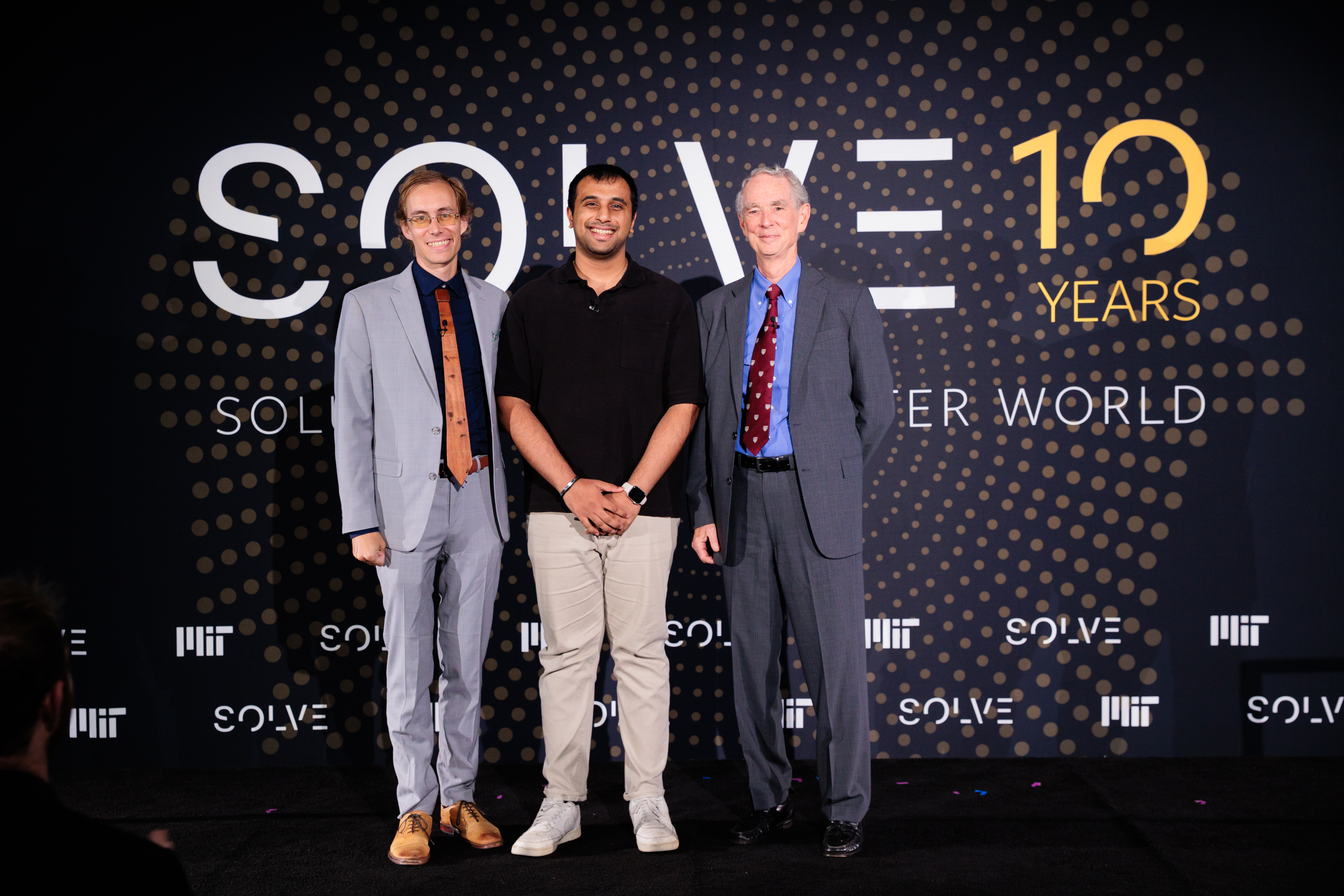
Our Chief Innovation Officer Michael McCreary recently handed out the award to Flint founder Carlo Charles during NYC Climate Week. To commemorate the news, Michael sat down with Carlo to hear more about the experiences that inspired the company, its journey from experiment to production and how the award will support its next phase of growth.
Here are some highlights from that discussion.
Michael McCreary: What inspired you to start Flint?
Carlo Charles: I grew up in the Philippines, where climate change was impossible to ignore. Typhoons, floods and landslides could close schools or leave communities without electricity and water for weeks. I remember seeing a neighbor’s house blown away overnight. Those experiences made me want to understand what was happening to the planet and what I could do about it.
At the same time, I loved building things. My father is an engineer, and he brought me to factory floors, where I learned to tinker from an early age. I began developing climate-focused projects when I was 12 and worked with many types of batteries. I realized that the battery was almost always the biggest constraint, whether because of its cost, size, safety or performance. Flint began as a passion project to rethink that problem.
Michael: When did you realize that idea could become a company?
Carlo: I was 18 when I started exploring paper batteries. Because I didn’t have a traditional background in battery chemistry, I wasn’t limited by assumptions about what was possible. Many people told me the idea would never work.
Building a functioning prototype changed that. Later, TechCrunch selected Flint as one of 20 startups to pitch at TechCrunch Disrupt in San Francisco. I was the youngest founder and the only participant from Asia in that group. That recognition helped me understand that the technology was different, and there was a real market for it.
Michael: How does Flint’s battery technology differ from conventional batteries?
Carlo: We started from the materials. Instead of trying to make existing lithium-ion technology incrementally better, we removed toxic or scarce materials such as lithium, nickel, cobalt and lead. Our chemistry uses abundant materials, including zinc and manganese, along with a water-based electrolyte.
Paper is one of our raw materials, but our process transforms it into a hydrogel-like material. The resulting battery is flexible and fire-resistant. It can even continue powering a device after being cut.
We also designed the technology with manufacturing in mind. Our process can use much of the equipment already found in battery production while eliminating certain complex steps. That gives us a more practical path toward scaling production efficiently.
Michael: Why did you pursue MIT Solve?
Carlo: We applied for three years in a row because I understood the value of the MIT Solve network. The relationships, expertise and opportunities it can provide are difficult to find through a typical accelerator.
Early on, our technology sounded too good to be true. We needed prototypes, customers and manufacturing progress to prove it was real. The Solve process also pushed us to think differently about impact. As engineers, we tracked outputs such as emissions and water use. MIT Solve challenged us to consider how many people’s lives our technology could improve and how we could follow that impact beyond the manufacturers using our batteries.
Michael: What made the E Ink Innovation Prize particularly meaningful?
Carlo: Shortly before learning about the award, I attended an IoT exhibition in China and saw E Ink technology used across many applications. I immediately thought about the natural connection between electronic paper and paper batteries.
The prize funding can help us scale production, expand our product portfolio and work with more brands to replace conventional batteries with safer alternatives. E Ink’s industry experience and relationships could also create opportunities for collaboration as we bring the technology into more products.
Michael: What comes next for Flint?
Carlo: We have proven the technology, demonstrated that it can be manufactured cost-effectively and seen strong customer interest. Our next milestone is getting Flint batteries into products that people use every day.
Batteries are only the first step in Flint’s larger vision. Our goal is to combat climate change through technology, and right now, batteries are one of the biggest challenges we can help solve.

Leave Comment